


Have you ever opened your electricity bill, looked at the total, and wondered, “How did we use so much electricity this month?”
You’re not alone.
Perhaps you’ve been using the same refrigerator for years. The air conditioner runs for hours during summer. The geyser stays switched on longer than necessary. Lights remain on in empty rooms, and chargers stay plugged in even when nobody is using them.
Individually, these habits may not seem like a big deal. But when several appliances run every day, their electricity consumption can add up.
The good news? You don’t necessarily need to stop using your favourite appliances or sacrifice your comfort to reduce your electricity bill.
Sometimes, the biggest improvements come from understanding which appliances consume the most electricity, using them more efficiently, and making a few practical changes to your daily routine.
For example, adjusting your air conditioner’s temperature, reducing unnecessary geyser heating, choosing efficient appliances when replacing old ones, and switching off equipment when it’s not needed can all help.
Of course, the amount you save depends on your electricity tariff, household size, appliance efficiency, weather, and usage habits. No single trick guarantees a dramatic reduction.
In this guide (How to Reduce Household Electricity Consumption) , we’ll explore 15 practical ways to reduce household electricity consumption, explain how common appliances affect your bill, and show you how to identify opportunities to save without making everyday life uncomfortable. Let’s start with the changes that can make the biggest difference.
This article may contain affiliate links. If you purchase through these links, we may earn a commission at no additional cost to you. Product availability, prices, specifications, and warranty terms can change, so please confirm the latest details with the manufacturer or retailer before purchasing.

Find Out How to Reduce Household Electricity Consumption Recognizing Which Appliances Consume the Most Electricity
Before changing your habits, take a moment to understand where your electricity goes.
Many households try to save electricity by switching off lights whenever they leave a room. That’s a good habit, but lighting may not be the biggest part of the bill.
Appliances that heat or cool things can use substantial amounts of electricity, depending on their power rating and how long they operate.
Common examples include:
- Air conditioners
- Electric water heaters and geysers
- Room heaters
- Electric ovens and cooking appliances
- Refrigerators
- Washing machines and clothes dryers
- Water pumps
The actual consumption varies widely between models and households.
For example, an air conditioner operating for several hours each day may use considerably more electricity than an LED bulb used for the same period.
How can you check an appliance’s electricity consumption?
Look for the appliance’s rated power in watts on its label or specifications.
You can estimate electricity consumption using this formula:
Electricity units = Power in watts × Operating hours ÷ 1,000
Suppose a hypothetical 1,000-watt appliance runs for two hours at full rated power.
The calculation is:
1,000 × 2 ÷ 1,000 = 2 units of electricity
One unit of electricity is equivalent to one kilowatt-hour.
Actual consumption may differ if the appliance cycles on and off, operates at variable power, or doesn’t draw its full rated power continuously.
Once you understand which appliances use the most electricity, you can focus your efforts where they matter most.
Pro tip: Keep your electricity bills for several months. Comparing usage across similar seasons can help you spot changes in consumption.
Use Your Air Conditioner More Efficiently
If your electricity bill rises sharply during summer, your air conditioner may be one of the first appliances to investigate.
Air conditioning is useful during hot weather, but inefficient settings, poor maintenance, and unnecessary operating hours can increase electricity consumption.
The good news is that you don’t have to stop using your AC to manage its energy use.
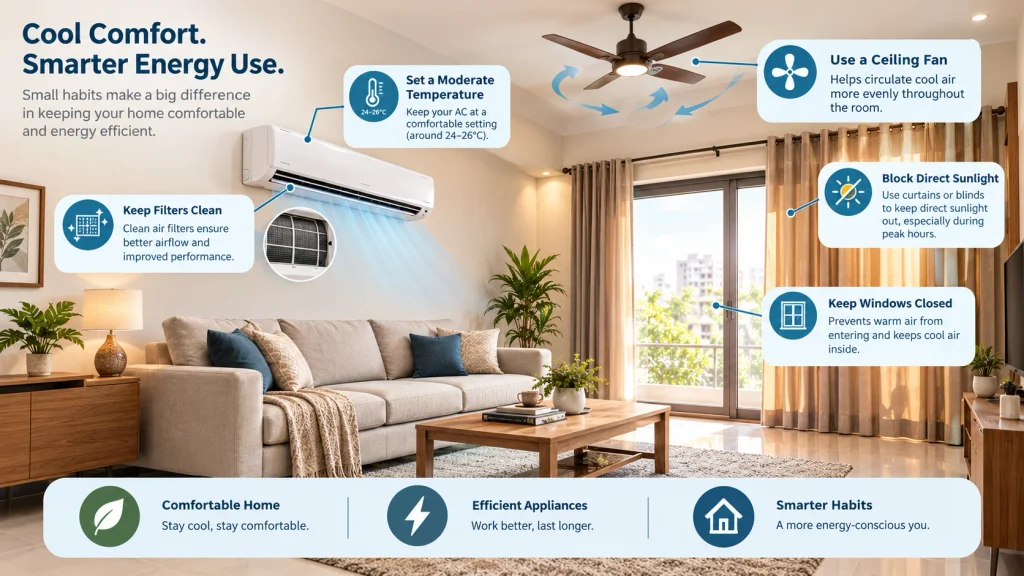
Set a comfortable temperature
Avoid setting the thermostat unnecessarily low.
A practical starting point for many households is around 24–26°C, depending on personal comfort, humidity, and outdoor conditions.
The right setting varies by person and climate, so choose a temperature that keeps your room comfortable.
Lowering the temperature much further doesn’t make the room cool instantly. It can, however, increase the amount of work the air conditioner needs to do.
Keep doors and windows closed
When the AC is running, close external doors and windows where practical.
Otherwise, warm outdoor air can enter the room, making the system work harder.
Curtains or blinds can also help reduce direct sunlight entering the room.
Clean the filters regularly
Dirty filters can restrict airflow and affect performance.
Follow the manufacturer’s instructions for cleaning or replacing them. Arrange professional servicing when needed.
Use a fan alongside the AC
A ceiling fan can improve air circulation and make a room feel more comfortable. This may allow you to use a slightly higher AC temperature, depending on your preferences.
Remember that the fan also consumes electricity, but it generally uses much less than an air conditioner.
The takeaway: Focus on comfortable thermostat settings, clean filters, good insulation, and avoiding unnecessary cooling.
Reduce Electricity Consumption From Your Geyser
A geyser is one of the appliances worth checking if your household uses hot water every day.
Storage water heaters consume electricity to heat the water inside their tanks. Some heat is also lost while the water is stored.
That doesn’t mean you should stop using hot water. It means you should avoid heating more water than necessary and follow the manufacturer’s instructions.
Switch it on when you need hot water
For a conventional storage geyser, you may be able to reduce unnecessary operation by heating water before use rather than leaving the heater on continuously.
However, check the manufacturer’s instructions and the appliance’s controls before changing your routine.
Some households have different hot-water schedules, so the best approach depends on your usage.
Choose an appropriate temperature
Follow the manufacturer’s guidance for a suitable thermostat setting.
Avoid unnecessarily high settings, which can increase energy use and create a scalding risk. If the heater has a mixing valve or temperature control, use it according to the manufacturer’s recommendations.
Choose the right geyser capacity
A tank that’s too large for your household may store more hot water than you typically need. A tank that’s too small may require repeated reheating or leave you waiting for hot water.
Consider the number of users, bathing habits, local winter conditions, and the appliance’s heating power.
Check the insulation and maintenance
A well-insulated tank helps reduce heat loss. If your geyser has performance problems, unusual noises, leakage, or excessive heating time, arrange an inspection by a qualified technician.
Never open or repair an electric water heater yourself unless you’re qualified to do so.
The takeaway: Use your geyser according to your household’s actual hot-water needs, and don’t overlook capacity, temperature, and maintenance.
Replace Old Bulbs With LED Lighting
If your home still uses older incandescent bulbs, switching to LED lighting can be a straightforward way to reduce electricity consumption.
LED bulbs generally provide similar brightness while using considerably less electricity than traditional incandescent bulbs.
Let’s compare a simple example.
Imagine replacing a hypothetical 60-watt incandescent bulb with a 9-watt LED bulb that provides suitable brightness.
The difference in power consumption is:
60 W − 9 W = 51 watts
If the bulb operates for five hours daily, the estimated daily electricity reduction is:
51 × 5 ÷ 1,000 = 0.255 units
Over 30 days, that’s approximately 7.65 units for that one bulb, assuming the same operating hours every day.
Your actual savings depend on the bulbs you replace, their brightness, and how long you use them.
What should you check when buying LED bulbs?
Look at:
- Brightness, measured in lumens
- Power consumption in watts
- Colour temperature
- Expected operating life
- Warranty and product quality
Don’t automatically choose the lowest-wattage bulb. Make sure it provides enough light for the room.
Pro tip: Start by replacing the bulbs you use for the longest periods. These may offer a more noticeable benefit than bulbs used for only a few minutes each day.
Choose Energy-Efficient Appliances
When an old appliance needs replacing, don’t compare models based only on the purchase price.
An appliance that costs less upfront may consume more electricity during its lifetime.
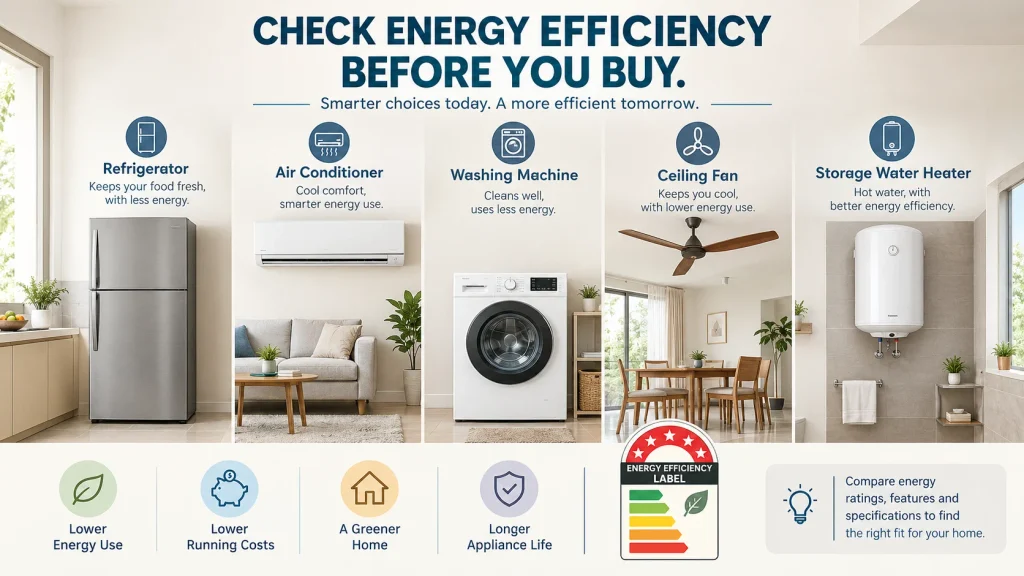
In India, the Bureau of Energy Efficiency’s star-label programme helps consumers compare the energy performance of covered appliances. The meaning of a rating depends on the appliance category and the applicable label standards.
Where a BEE label is available, compare the ratings and any listed annual energy-consumption information.
Which appliances should you compare carefully?
Consider energy efficiency when purchasing:
- Air conditioners
- Refrigerators
- Washing machines
- Ceiling fans
- Electric water heaters
- Other frequently used appliances covered by relevant rating programmes
Remember that star ratings should be compared within the relevant product category and applicable rating period.
A more efficient model may cost more initially, but the difference can be worthwhile if the appliance runs frequently.
Buying tip: Check the latest label, specifications, warranty, service availability, and estimated running costs before making a purchase.
Switch Off Appliances When You’re Not Using Them
It sounds obvious, but many households leave appliances running longer than necessary.
Lights stay on in empty rooms. Fans run after everyone leaves. Televisions remain switched on when nobody is watching.
These habits are easy to correct.
Make it a routine to check lights, fans, televisions, and other equipment before leaving a room or going to bed.
However, don’t switch off appliances blindly.
Some devices need continuous power, including certain refrigerators, security systems, networking equipment, and medical devices. Follow the manufacturer’s guidance.
What about standby power?
Some electronics continue drawing small amounts of electricity when switched off using a remote or left in standby mode.
The amount varies by device.
You can consider switching off suitable equipment at the mains or using an appropriate power strip when devices are not needed.
Don’t disconnect equipment that needs continuous power or that could be damaged by frequent power cycling.
Simple habit: Before leaving home, do a quick check of lights, fans, and non-essential electronics.
Small changes become more useful when you repeat them every day.
Use Your Refrigerator Efficiently
Your refrigerator is different from many other appliances because it operates throughout the day.
You can’t simply switch it off whenever you leave home, but you can make sure it works efficiently.
Keep the door closed
Every time you open the refrigerator, warmer air enters.
Repeatedly opening the door or leaving it open for long periods can increase the cooling workload.
Decide what you need before opening it, and close the door promptly.
Check the temperature settings
Follow the manufacturer’s recommended settings for the refrigerator and freezer compartments.
Avoid making the compartments colder than necessary.
Allow proper ventilation
Leave the recommended clearance around the appliance so heat can escape.
Poor ventilation can affect performance.
Check the door seals
Damaged or loose door seals may allow cold air to escape.
If the seal is damaged, arrange repair or replacement as appropriate.
Avoid putting hot food directly inside
Allow food to cool appropriately before refrigerating it, while following food-safety guidance. Don’t leave perishable food at room temperature for unsafe periods simply to reduce the refrigerator’s workload.
The takeaway: Good refrigerator habits can help reduce unnecessary cooling demand without compromising food safety.
Use Washing Machines Wisely
Washing machines can use electricity for running the motor, controls, and water-heating functions where fitted.
Your usage habits affect the total.
Wash full loads when practical
Running several small loads may use more resources than washing an appropriately sized full load.
Don’t overload the machine, though. Follow the manufacturer’s recommended capacity.
Use cold-water cycles when suitable
Heating water can add to electricity consumption.
For normally soiled everyday clothing, a suitable cold-water cycle may be sufficient. Follow garment care instructions and the washing machine’s guidance.
Some loads may require warmer water for cleaning or hygiene reasons.
Choose an appropriate cycle
Use the shortest suitable cycle for lightly soiled clothing, rather than selecting a heavy-duty programme for every wash.
Avoid unnecessary extra rinses
Use additional rinse cycles when needed, not automatically for every load.
Pro tip: Combine laundry into suitable loads and choose the right programme for the clothes. This can reduce unnecessary machine operation.
Use Your Ceiling Fans Properly
Ceiling fans generally consume much less electricity than air conditioners, making them useful for improving comfort.
However, a fan cools people mainly by moving air across the skin. It doesn’t lower the room’s air temperature in the same way an air conditioner does.
This distinction matters.
Switch fans off in empty rooms rather than leaving them running unnecessarily.
During hot weather, use fans where people are present, and combine them with appropriate ventilation or air conditioning when needed.
If you’re buying a new fan, compare its power rating, airflow performance, and relevant energy-efficiency information.
An efficient fan can be particularly useful in rooms where it runs for many hours each day.
Reduce Unnecessary Electric Heating
Electric room heaters and other resistance-heating appliances can consume substantial electricity while operating.
If you use an electric room heater during winter, consider whether you can reduce unnecessary operating time without compromising comfort or safety.
Practical steps include:
- Close doors and windows to reduce drafts.
- Use curtains where they help limit heat loss.
- Heat only the occupied area when practical.
- Follow the heater’s safety instructions.
- Switch it off when it’s no longer needed.
Never cover a room heater, leave it close to flammable materials, or operate it contrary to the manufacturer’s instructions.
For water heaters, the same principle applies: heat the amount of water you need, use sensible settings, and avoid unnecessary heating.
Important: Comfort and safety should come first. Don’t use unsafe heating arrangements to save electricity.
Make Better Use of Natural Daylight
Why switch on every light during the day if sunlight already illuminates your room?
Where practical, open curtains and blinds to let natural daylight into your home.
Arrange desks and frequently used spaces near suitable windows if this works for your room layout.
You may also want to use lighter curtains or keep window areas clear of unnecessary obstructions.
But there is one thing to remember: sunlight can also increase indoor heat, particularly during hot weather.
In summer, direct sunlight through windows may increase the need for air conditioning. Curtains, blinds, or external shading can help manage this.
The goal is balance: use natural light when it helps, but control heat gain when cooling becomes important.
Reduce Unnecessary Water Pump Operation
If your home uses an electric water pump, its operating time contributes to electricity consumption.
A pump that runs longer than necessary may indicate a problem with the water system.
Check for issues such as:
- Leaking pipes or taps
- Faulty float switches
- Incorrect automatic controls
- Unusual pump cycling
- Water storage or pressure problems
A pump should operate according to its design and household requirements.
Don’t run it dry or alter electrical connections yourself.
If the pump switches on repeatedly without an obvious reason, have a qualified plumber or technician investigate.
Fixing a problem can improve convenience and may prevent unnecessary operation.
Check Your Electricity Bill and Meter Readings
If you want to reduce household electricity consumption, don’t rely only on memory.
Check your electricity bills and compare the number of units used over time.
Your bill may show:
- Units consumed
- Billing period
- Meter readings
- Applicable tariff
- Fixed charges
- Taxes or other fees
- Adjustments or previous balances
This distinction is important because a higher bill doesn’t always mean you consumed more electricity.
The total may also change because of tariff revisions, billing-period differences, fixed charges, or adjustments.
How to track your usage
Record the meter reading at regular intervals, such as once a week, if your meter and utility arrangements allow it.
Compare readings across similar periods and seasons.
For example, electricity consumption may naturally rise during a hot summer when air conditioning is used more frequently.
If the reading suddenly increases without an obvious explanation, investigate appliance use and possible faults.
For safety, don’t open the meter or tamper with electrical equipment. Contact your electricity provider or a qualified electrician when needed.
Use Timers and Smart Controls Where Appropriate
Timers and smart controls can help you avoid running certain appliances longer than necessary.
Depending on the device, they may help manage:
- Selected lighting
- Compatible fans
- Some heating systems
- Non-essential electronics
- Other suitable household equipment
For example, a timer may help switch off a light automatically after a set period.
However, compatibility and safety matter.
Don’t connect a high-power geyser, air conditioner, or other heavy-load appliance to a cheap timer or smart plug unless the device is explicitly rated for that load and installation.
For high-power equipment, use the manufacturer’s built-in controls or have a qualified electrician recommend a suitable solution.
Smart controls are most useful when they solve a specific problem, such as forgetting to switch something off.
Buying smart devices without a clear purpose may add cost without meaningful savings.
Create a Simple Household Electricity-Saving Routine
You don’t need to change everything in one day.
Instead, build a routine that fits your household.
Here’s a simple example.
Morning
- Switch on the geyser according to your hot-water needs and the manufacturer’s guidance.
- Use natural daylight when practical.
- Switch off lights and fans in empty rooms.
- Run the washing machine with an appropriate load when needed.
Afternoon
- Use the AC at a comfortable setting.
- Keep windows closed while cooling is active, where practical.
- Avoid leaving televisions or other electronics running unnecessarily.
- Check whether fans and lights are needed in unoccupied rooms.
Evening
- Use suitable LED lighting.
- Switch off unnecessary appliances after use.
- Keep refrigerator doors closed.
- Check that heating and cooling appliances are being used as intended.
Before bed
- Switch off non-essential lights and equipment.
- Check the AC or fan settings.
- Make sure essential devices remain connected where required.
- Follow the safety instructions for heaters and other appliances.
The best routine is one your family can follow consistently.

How Much Can You Save by Reducing Electricity Consumption?
This is the question most households want answered.
The honest answer is that your savings depend on your current consumption, electricity tariff, appliances, and the changes you make.
Let’s look at a simple hypothetical example.
Suppose you replace an older 60-watt bulb with a 9-watt LED bulb. The bulb is used for five hours each day.
As calculated earlier, the estimated reduction is around 7.65 electricity units per month.
If your applicable marginal electricity rate were ₹8 per unit, the estimated energy-charge reduction would be:
7.65 × ₹8 = ₹61.20 per month
This is an illustration, not a guaranteed saving. Your actual bill may differ because of your tariff structure, taxes, fixed charges, and usage.
Now imagine making several improvements across different appliances.
You might reduce unnecessary AC operation, improve refrigerator habits, use the geyser more sensibly, and replace frequently used older bulbs with suitable LEDs.
Each change may contribute differently.
Rather than trusting claims that one trick will cut your bill by a fixed percentage, track your actual consumption and evaluate what works in your home.
A simple way to calculate your potential savings
Use this formula:
Estimated savings = Electricity units saved × Applicable electricity rate per unit
If you reduce consumption by 20 units in a month and your applicable marginal rate is ₹8 per unit, the estimated reduction in energy charges is ₹160.
The final bill reduction may differ because electricity tariffs can include fixed charges, taxes, slab-based rates, and other components.
Final Verdict: Start With the Changes That Matter Most
Reducing household electricity consumption doesn’t mean giving up air conditioning, hot showers, comfortable lighting, or the appliances you use every day.
It means using them more thoughtfully.
Start by identifying the appliances that contribute most to your consumption. Use your AC efficiently, avoid unnecessary geyser heating, replace frequently used older bulbs with suitable LEDs, maintain your refrigerator, and switch off non-essential equipment when it’s not needed.
When replacing an appliance, compare energy efficiency alongside price, capacity, warranty, and service availability.
Most importantly, track your electricity usage over time. That will help you distinguish genuine improvements from normal seasonal changes or differences in billing.
You don’t need to change your entire home overnight. Start with two or three practical habits, follow them consistently, and review your electricity consumption next month.
Small improvements can add up, especially when they target appliances that operate frequently.
Want to Make Your Home More Energy-Efficient?
If you’re planning to replace an old appliance, compare energy ratings, power consumption, product specifications, and warranty terms before purchasing.
This article may contain affiliate links. If you purchase through these links, we may earn a commission at no additional cost to you. Product availability, prices, specifications, and warranty terms can change, so please confirm the latest details with the manufacturer or retailer before purchasing.
Frequently Asked Questions
What is the easiest way to reduce household electricity consumption?
Start by reducing unnecessary operating time for high-use appliances, using air conditioning efficiently, replacing frequently used older bulbs with LEDs, and switching off non-essential equipment when not needed.
Which household appliances consume the most electricity?
Air conditioners, electric water heaters, room heaters, and other heating or cooling appliances can consume substantial electricity. The actual amount depends on their power rating, efficiency, and operating time.
Does switching off appliances at the plug save electricity?
It can reduce standby consumption for suitable devices. However, some appliances need continuous power, so follow the manufacturer’s instructions before disconnecting them.
How can I reduce my electricity bill in summer?
Use the AC at a comfortable setting, clean its filters, limit heat entering through windows, use fans where helpful, and switch off cooling equipment when it is no longer needed.
Does leaving a geyser switched on increase electricity consumption?
A storage geyser can lose heat while storing hot water, so it may periodically use electricity to maintain the temperature. The amount depends on the model, insulation, thermostat, and usage pattern. Follow the manufacturer’s operating guidance.
Do LED bulbs really help save electricity?
LED bulbs generally use less electricity than traditional incandescent bulbs for similar brightness. The benefit depends on the bulbs replaced and how many hours they are used.
How can I check my home’s electricity consumption?
Compare the units shown on your electricity bills or record suitable meter readings over time. You can also estimate an appliance’s consumption using its power rating and operating hours, keeping in mind that actual power draw may vary.
Should I replace every old appliance with a new energy-efficient model?
Not necessarily. Compare the appliance’s condition, expected remaining life, energy consumption, purchase cost, and likely usage. Replacing a frequently used, inefficient appliance may offer more benefit than replacing something that is rarely used.