

Imagine it’s a cold winter morning.
You’ve switched on the geyser, waited for the water to heat, and finally stepped into the bathroom. Everything feels perfect until the hot water suddenly runs out halfway through your shower.
Now you’re standing there wondering whether you bought the wrong geyser.
Here’s another situation.
You bought a large-capacity water heater because you thought bigger must be better. It takes up a significant amount of bathroom space, costs more than you expected, and you rarely use all the hot water it stores.
Both situations come down to one important decision: choosing the right geyser capacity for your home.
If you’re planning to buy a new water heater, you’ve probably come across options such as 10 litres, 15 litres, and 25 litres. You may also have noticed that different websites recommend different sizes for the same household.
So, How to Choose the Right Geyser Capacity?
Is a 10-litre geyser enough for a bathroom? Is a 15-litre model suitable for a family of four? Should you spend more on a 25-litre geyser for winter?
The answer depends on more than the number of people living in your home.
Your bathing habits, shower type, incoming water temperature, available space, and the amount of hot water you use all play a role.
In this guide, we’ll break down the differences between common geyser capacities, explain which sizes may suit different households, and help you avoid buying a water heater that’s either too small or unnecessarily large.
Let’s find the right size for your home.
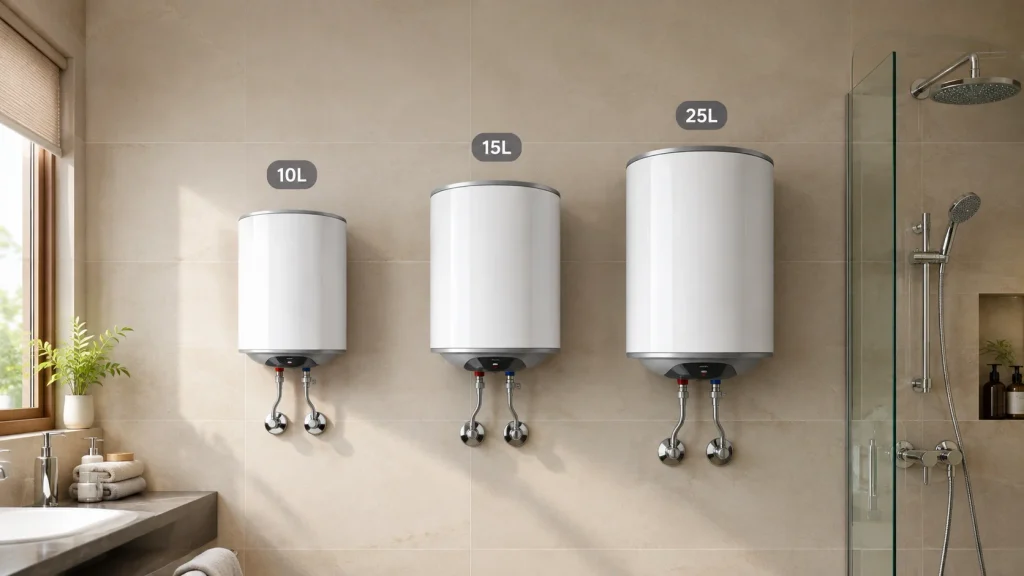
What Does Geyser Capacity Actually Mean?
Before comparing sizes, let’s clear up one common misunderstanding.
When a storage geyser is advertised as a 10L, 15L, or 25L model, the number refers to the nominal capacity of its water storage tank.
For example:
- A 10L geyser has a nominal storage capacity of around 10 litres.
- A 15L geyser has a nominal storage capacity of around 15 litres.
- A 25L geyser has a nominal storage capacity of around 25 litres.
But this doesn’t mean a 15-litre geyser can provide only 15 litres of usable bathing water.
Why?
Because you generally mix hot water with cold water to get a comfortable temperature. The amount of mixed water you can use depends on how hot the tank gets, how cold the incoming water is, and how much hot water you mix into the supply.
For example, if the stored water is considerably hotter than your preferred bathing temperature, you can mix it with cold water to produce a larger quantity of comfortable bathing water.
However, the exact amount varies with the temperatures involved, the appliance’s performance, and water-flow conditions.
Here’s the important takeaway: Don’t judge a geyser only by its litre rating. Think about how much comfortably warm water you need and how quickly your household uses it.
Also, capacity isn’t the same as heating speed. A larger tank generally needs more energy to heat from the same starting temperature, while the time required depends on the heater’s power rating and other conditions.
10L vs 15L vs 25L Geyser: Which Size Is Best?
Let’s compare the three common storage geyser capacities you’ll frequently see while shopping.
Is a 10-Litre Geyser Enough for Your Home?
A 10-litre storage geyser can be a practical option for smaller hot-water requirements.
It may suit a compact household, a bathroom with modest hot-water demand, or a location where people generally take short baths.
However, whether it’s enough depends on how you bathe.
If you use a bucket and mug, your hot-water needs may be different from those of someone who prefers a long shower. A 10-litre tank may also be less convenient when several people need hot water one after another.
Who should consider a 10L geyser?
A 10-litre model may be worth considering if:
- You live alone or have relatively low hot-water demand.
- You take short baths.
- You need hot water for a small bathroom.
- You have limited installation space.
- You don’t regularly need large quantities of hot water at once.
When might a 10L geyser feel too small?
Imagine two adults and two children getting ready for school on a cold morning.
If everyone needs hot water within a short period, a small tank may become inconvenient. You might need to wait for the water to heat again before the next person finishes bathing.
That doesn’t mean a 10-litre geyser is always unsuitable for a family. It means you should consider your actual usage instead of choosing based on household size alone.
Our verdict: A 10L geyser may work well for modest hot-water needs, but compare its expected output with your bathing routine before buying.
Is a 15-Litre Geyser the Best All-Round Choice?
The 15-litre storage geyser is a popular option to consider for everyday bathroom use.
It offers more storage capacity than a 10-litre model without requiring as much space as some larger tanks.
For households with moderate hot-water demand, this can be a useful middle ground.
However, the phrase “best all-round choice” doesn’t mean a 15-litre geyser will suit everyone. A household that uses lots of hot water may need a larger tank, while someone with very low demand may not need 15 litres.
Who should consider a 15L geyser?
A 15-litre model may suit:
- Individuals or couples with regular bathing needs.
- Smaller households with moderate hot-water consumption.
- Bathrooms where space is limited but a little extra storage is useful.
- People who want a balance between tank size and everyday convenience.
Is 15 litres enough for a family of four?
It depends.
If family members take relatively short baths, mix hot and cold water efficiently, and don’t all use large amounts of hot water back-to-back, a 15-litre model may be adequate in some homes.
But if everyone prefers longer showers, the same capacity may feel limiting.
Also consider whether you need hot water at multiple outlets, such as a bathroom shower and a washbasin, around the same time.
Our verdict: A 15L geyser is worth comparing if your household has moderate hot-water needs. Don’t assume it’s automatically sufficient for every family of three or four.
Should You Buy a 25-Litre Geyser?
If your household regularly uses a larger amount of hot water, a 25-litre storage geyser may be worth considering.
Its larger tank can store more heated water than a 10L or 15L model, which may make it more convenient for higher-demand households.
This can be especially useful when several people bathe one after another and you want a larger prepared supply.
However, a bigger tank isn’t automatically the better purchase.
A 25-litre geyser generally takes up more room, and heating a larger volume of water from the same starting temperature requires more energy. It may also cost more, depending on the model.
Who should consider a 25L geyser?
A 25-litre model may be suitable for:
- Households with higher hot-water demand.
- Families where several people bathe during the same period.
- People who prefer longer baths or showers.
- Homes where a larger storage tank fits the available installation space.
- Situations where the extra stored water provides a practical benefit.
Is a 25L geyser always better for winter?
Not necessarily.
A larger tank can be useful when more hot water is needed, but winter performance also depends on the incoming water temperature, the heater’s power rating, and how much hot water is consumed.
If your household uses relatively little hot water, buying a larger tank may not offer enough practical benefit to justify the additional cost and space.
Our verdict: Consider 25L when your hot-water demand genuinely calls for it. Don’t buy a larger geyser simply because you assume it will always be more efficient or economical.

What Geyser Capacity Is Best for a Family of 2, 3, 4, or 5?
This is where many buyers get confused.
You may see a recommendation suggesting that a family of four should buy a 15-litre geyser, while another recommends 25 litres.
Both recommendations may make sense in different circumstances.
The number of people matters, but it isn’t the only factor.
Here’s a practical starting point for comparing storage geyser capacities.
| Household Situation | Capacity to Consider | Important Considerations |
|---|---|---|
| One person with modest hot-water needs | 10L or 15L | Bathing method and frequency |
| Couple with moderate demand | 10L or 15L | Shower duration and preferred water temperature |
| Family of three | 15L or 25L | Whether hot water is used back-to-back |
| Family of four | 15L or 25L | Bathing habits, climate, and peak demand |
| Larger household with higher demand | 25L or a larger suitable model | Number of users, outlets, and timing |
These are starting points, not strict rules.
A family of four that takes short bucket baths may have different requirements from a couple who prefer long showers.
Similarly, a family may find a 15L model adequate during warmer months but prefer more storage capacity when incoming water becomes colder.
Before deciding, ask yourself:
- How many people use the geyser daily?
- How much hot water does each person typically need?
- Do people bathe one after another or at different times?
- Is the water used mainly for showers, bucket baths, or both?
- How cold does the incoming water get during winter?
These questions will give you a more realistic answer than household size alone.
Does Your Bathing Style Affect Geyser Capacity?
Absolutely.
Two households with the same number of people may need different geyser sizes because they use hot water differently.
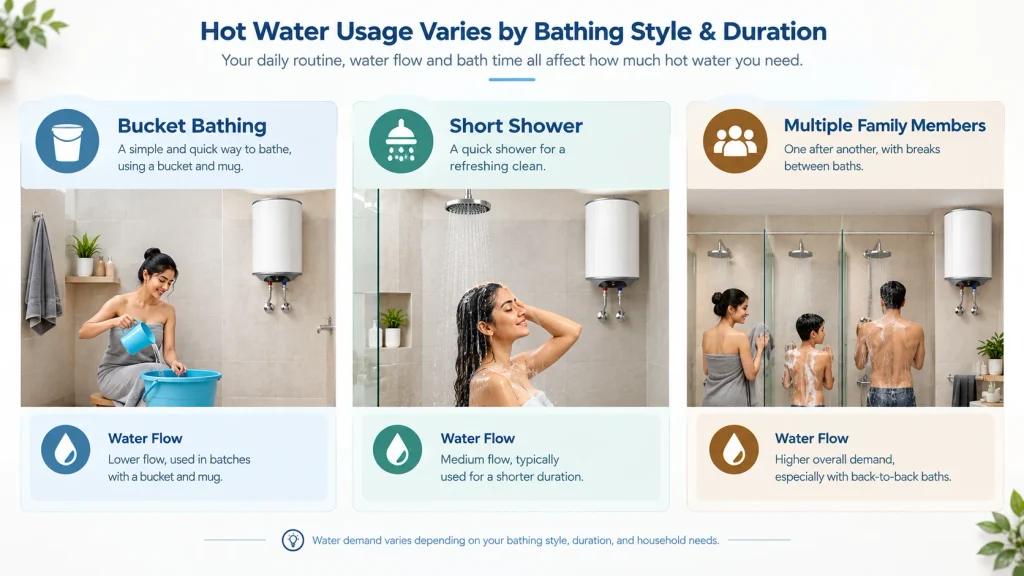
Let’s look at three common situations.
Bucket Bathing
If you use a bucket and mug, you have more direct control over how much water you use.
You can mix hot and cold water in the bucket to reach a comfortable temperature. Depending on the temperature difference, a relatively small quantity of stored hot water may produce a larger quantity of mixed bathing water.
For this reason, a 10L or 15L geyser may be worth considering for modest bucket-bathing needs.
However, the actual amount of usable water depends on the stored temperature, incoming cold-water temperature, and how much water you use.
Shower Bathing
Showers can use water continuously, so the amount of hot water needed depends heavily on the shower’s flow rate and the duration of the shower.
A high-flow shower used for 15 minutes can demand considerably more water than a short shower with a lower flow rate.
A 15L geyser might be sufficient for one person’s shorter shower in some conditions, but it may not suit everyone.
If you regularly take longer showers, compare larger storage capacities and the manufacturer’s expected hot-water performance.
Multiple People Bathing Back-to-Back
This is where storage capacity becomes especially important.
Imagine one person finishes bathing and the next person enters the bathroom immediately.
The tank may still contain hot water, but the available quantity and temperature depend on how much was used by the first person.
A larger tank can provide a bigger initial reserve, although the exact usable supply depends on the heater and water temperatures.
If your family regularly uses hot water back-to-back, don’t choose a geyser without considering total demand during that period.
How Does Winter Affect the Geyser Size You Need?
If you live in a region with cold winters, this section deserves special attention.
During winter, incoming water is colder. Your water heater must raise it to your desired temperature, which requires more energy than heating the same amount of water from a warmer starting temperature.
This affects both instant and storage water heaters, although their performance works differently.
With a storage geyser, a larger tank may be helpful when you need a larger prepared supply of hot water.
With an instant geyser, the power rating and flow rate are particularly important because the appliance must heat water as it passes through.
Should you buy a bigger geyser just for winter?
Not automatically.
First, consider how much hot water you actually use during winter.
If your existing capacity is nearly sufficient and the main issue is colder incoming water, a larger tank may help in some situations, but it won’t necessarily solve every performance issue.
You should also compare the appliance’s heating power, thermostat setting, insulation, and recommended use.
For storage geysers, good insulation helps reduce heat loss while water is stored. However, no insulated tank retains heat indefinitely.
Practical advice: If winter bathing is your biggest concern, prioritise the combination of appropriate capacity, heating performance, insulation, and safe installation rather than buying the largest model available.
Does a Bigger Geyser Consume More Electricity?This is one of the most common reasons people hesitate before buying a 25L geyser.
The answer needs a little explanation.
Heating a larger quantity of water through the same temperature increase generally requires more energy than heating a smaller quantity.
For example, a 25-litre tank usually requires more energy to heat from the same starting temperature to the same target temperature than a 10-litre tank.
But that doesn’t mean a larger geyser will always produce a higher electricity bill in every household.
Your actual consumption depends on how much hot water you use, how often you heat it, the incoming water temperature, the target temperature, and heat loss during storage.
A larger tank may also mean you can meet a higher demand without needing to reheat water as frequently. Whether that is more economical depends on your usage pattern and the appliance’s efficiency.
How can you manage electricity consumption?
Here are some practical steps:
- Choose a capacity that matches your typical hot-water needs.
- Avoid heating more water than you are likely to use.
- Use the thermostat setting recommended by the manufacturer.
- Check the heater’s energy information, where available.
- Maintain the appliance according to the manufacturer’s instructions.
- Ask a qualified technician to investigate unusual energy use or heating problems.
The goal isn’t to buy the smallest geyser possible. It’s to choose a size that provides enough hot water without unnecessary expense.
5 Mistakes to Avoid When Choosing Geyser Capacity
Before you buy, watch out for these common mistakes.
Choosing based only on family size
A family of four doesn’t automatically need a 25L geyser, and a family of two doesn’t automatically need only 10L.
Your bathing habits and peak hot-water demand matter just as much.
Assuming a 15L geyser is always enough
A 15L model may be a good fit for some households, but people who take long showers or use hot water back-to-back may need a larger capacity.
Buying the largest geyser available
More storage can be useful, but a large tank also requires more space and typically more energy to heat from the same starting temperature.
Don’t pay for capacity you don’t need.
Ignoring the heating power
Two geysers with similar storage capacity may have different heating performance because of differences in power rating and design.
Check the manufacturer’s specifications rather than assuming that all 15L models heat water equally quickly.
Forgetting installation requirements
Before purchasing, check the product’s dimensions, mounting requirements, electrical specifications, and plumbing arrangements.
A suitable capacity is only part of a good buying decision. The appliance must also fit your space and be installed safely.
What Else Should You Check Before Buying a Geyser?
Once you’ve narrowed down the capacity, compare the individual products.
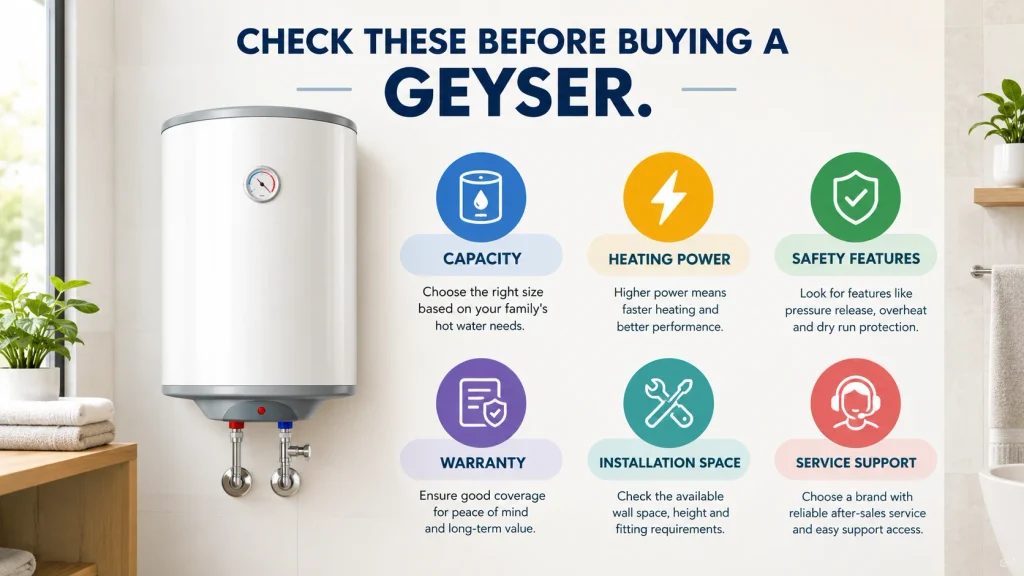
Use this checklist before placing an order.
Safety features: Check the manufacturer’s stated safety protections and installation requirements.
Heating power: Confirm the rated wattage and expected heating performance.
Tank construction: Review the tank material, corrosion protection, and other construction details listed by the manufacturer.
Warranty: Check the warranty period and conditions for the appliance, tank, and heating element, where applicable.
Dimensions: Make sure the unit fits the intended wall space and allows the required installation clearances.
Service availability: Check whether authorised service is available in your area.
Installation costs: Find out whether professional installation is included or charged separately.
Reviews: Look for recurring feedback about heating performance, reliability, leakage, and after-sales support.
Price: Compare the current price and specifications across suitable models before choosing.
Remember that features and warranty terms vary between products. Confirm the current information on the manufacturer’s documentation and the retailer’s listing rather than relying on assumptions.
Ready to compare geysers?
If you’ve identified the capacity that suits your household, the next step is to compare models with the right heating power, safety features, warranty, and installation requirements.
Frequently Asked Questions About Geyser Capacity
Which geyser capacity is best for a family of four?
A 15L or 25L storage geyser may be worth comparing, depending on bathing habits, the number of people using hot water at the same time, and local winter conditions. A family taking short bucket baths may need less hot water than one taking long showers.
Is a 10-litre geyser enough for a bathroom?
It can be sufficient for modest hot-water needs, particularly where people take short baths. However, it may be limiting for longer showers or several users bathing one after another.
Is a 15-litre geyser better than a 25-litre geyser?
Neither is universally better. A 15L model may be sufficient for moderate demand and can take up less space. A 25L model may be more convenient for households that need a larger supply of stored hot water.
Does a 25L geyser take longer to heat?
All else being equal, heating more water through the same temperature increase requires more energy. Actual heating time depends on the heater’s power rating, starting water temperature, thermostat setting, and design.
Which geyser capacity is best for winter?
The best capacity depends on how much hot water you need and how cold the incoming water gets. A larger tank can help when demand is high, but heating performance, insulation, and power rating also matter.
Can I use a 15L geyser for a shower?
Possibly. Whether it provides enough hot water depends on the shower’s flow rate, shower duration, incoming water temperature, and the geyser’s performance. Check the manufacturer’s guidance before purchasing.
Does a bigger geyser always mean a higher electricity bill?
Not necessarily. Heating a larger volume of water requires more energy when the temperature increase is the same, but actual bills depend on total hot-water usage, heating frequency, storage losses, and appliance efficiency.
Should I choose geyser capacity based on the number of bathrooms?
The number of bathrooms is relevant, but it isn’t the only factor. Consider how many outlets may need hot water simultaneously, the type of plumbing arrangement, and the manufacturer’s guidance on suitable applications.
Final Verdict: Which Geyser Capacity Should You Buy?
Choosing the right geyser capacity doesn’t have to be complicated.
If you have modest hot-water needs and prefer a compact setup, a 10L storage geyser may be worth considering.
If you need a practical option for moderate everyday use, compare 15L models and check whether their capacity suits your bathing routine.
If your household uses more hot water, especially when several people bathe one after another, a 25L geyser may be the better option.
But don’t make the final decision based on these labels alone.
Think about how you bathe, how much water you use, how cold the incoming water gets, and how quickly your household needs hot water. Then compare the appliance’s heating power, safety features, warranty, dimensions, and installation requirements.
The right geyser is not necessarily the biggest or the cheapest. It’s the one that supplies enough hot water for your daily routine without making you pay for capacity you rarely use.
Before ordering, compare a few suitable models and confirm their specifications and current prices.
Affiliate Disclosure
This article may contain affiliate links. If you purchase through these links, we may earn a commission at no additional cost to you. Product prices, availability, specifications, and warranty terms can change, so please verify the latest details with the manufacturer or retailer before buying.



Pingback: Instant vs Storage Water Heater: 7 Key Differences You Must Know Before Buying
Pingback: Crompton Water Geyser Review: Pros, Cons & Buying Guide