
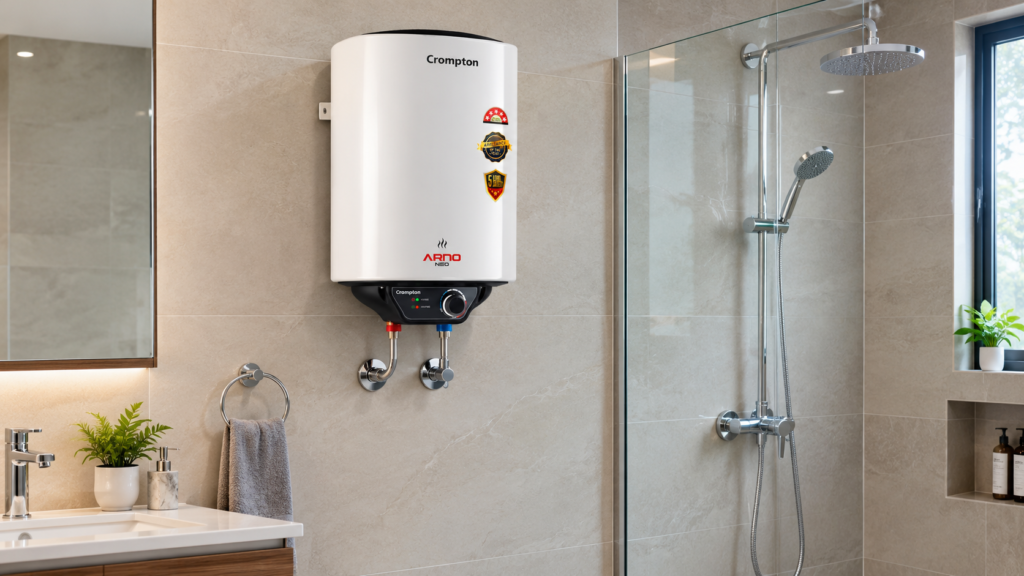

Planning to buy a new geyser before winter arrives? Wait! Choosing the wrong water heater could leave you waiting for hot water, struggling with limited capacity, or paying more for electricity than you expected.
The two most popular options instant and storage water heaters work differently, and neither is the perfect choice for every home. One heats water on demand, while the other stores heated water for later use. But which one offers the best balance of convenience, running costs, and performance?
In this guide, we’ll compare instant vs storage water heaters in simple terms, uncover their biggest advantages and disadvantages, and help you choose the right geyser for your bathroom, family size, and budget.
Imagine this.
It’s a chilly winter morning. You’re already running late, the bathroom feels freezing, and all you want is a warm shower before starting your day. You switch on the geyser, wait a few minutes, and check the water. It’s still cold.
Frustrating, right?
Now imagine buying a new water heater that heats water quickly, fits your bathroom perfectly, and doesn’t leave you worrying about your electricity bill.
Sounds good but there’s one important decision to make first.
Should you buy an instant water heater or a storage water heater?
Both types have their advantages, and choosing the wrong one can lead to everyday inconvenience. An instant geyser may be ideal if you need hot water quickly for washing utensils or taking short showers. A storage geyser may be more practical if your family needs a larger supply of hot water during cold winter mornings.
But the differences go beyond heating speed.
Capacity, electricity consumption, installation requirements, bathroom space, and the number of people in your household all matter.
In this guide, we’ll explain the difference between instant vs storage water heaters in simple language, compare their advantages and disadvantages, and help you decide which type makes the most sense for your home.
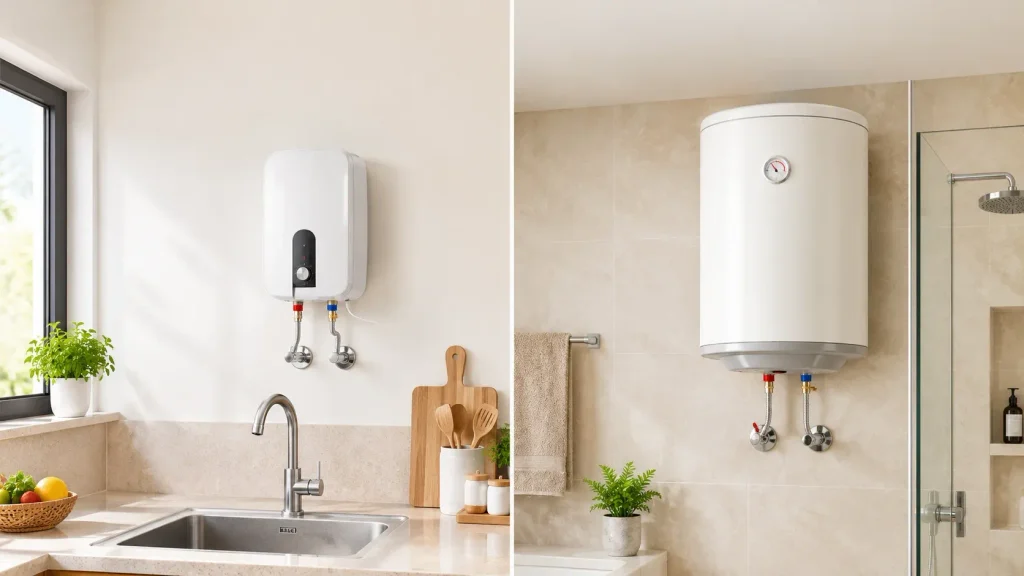
What Is an Instant Water Heater?
An instant water heater, often called an instant geyser, heats water as it passes through the appliance.
Unlike a storage model, it generally doesn’t keep a large quantity of hot water in a tank. Instead, water flows through a heating system, gets heated, and comes out through the outlet.
Because it doesn’t need to heat a full tank in advance, an instant water heater can provide hot water relatively quickly.
However, there’s an important detail: instant heating doesn’t necessarily mean unlimited hot water at any temperature or flow rate. The heater’s power rating, incoming water temperature, and water flow all affect how warm the water becomes.
Where is an instant geyser useful?
An instant water heater can be a good choice for:
- Kitchen sinks where you need warm water for washing.
- Small bathrooms with limited wall space.
- Handwashing and other short-duration tasks.
- Homes where hot water demand is relatively low.
- Locations where a compact appliance is preferred.
For example, if you mainly need warm water to wash dishes or rinse your hands during winter, a compact instant heater may be a practical solution.
But if several family members want long showers one after another, you should check whether the model can provide the required temperature and flow rate.
Advantages of an instant water heater
1. Compact design
Instant geysers are generally smaller than storage models. This makes them attractive for compact kitchens and bathrooms.
2. Hot water on demand
You don’t normally need to wait for a large tank to heat up before using water. The actual waiting time depends on the model, power rating, and incoming water temperature.
3. No large storage tank
The absence of a large hot-water storage tank can make installation easier in spaces where room is limited, although suitable plumbing and electrical arrangements are still necessary.
4. Potentially less standby heat loss
Because an instant model generally doesn’t keep a large tank of water hot for extended periods, it can avoid much of the standby heat loss associated with storage heaters.
That doesn’t automatically mean it will always consume less electricity. The amount of water you use, the temperature you need, and the appliance’s efficiency all influence consumption.
Disadvantages of an instant water heater
Instant geysers also have limitations.
- Some models may struggle to provide sufficiently hot water at high flow rates.
- Lower-powered models may be unsuitable for long showers in very cold weather.
- Electrical requirements can be significant for higher-powered models.
- They may not be ideal when several people need a continuous supply of hot water.
- The installation must meet the manufacturer’s electrical and plumbing requirements.
The bottom line: An instant water heater is worth considering when you want a compact appliance for relatively short hot-water tasks and the model’s heating capacity matches your needs.
What Is a Storage Water Heater?
A storage water heater, commonly called a storage geyser, heats water inside an insulated tank.
You switch it on, the heating element warms the water, and the tank stores that hot water until you’re ready to use it.
Storage geysers are available in different capacities, including common options such as 10 litres, 15 litres, and 25 litres. Larger capacities are also available.
The right size depends on your household, bathing habits, climate, and whether the water heater will serve one or multiple outlets.
For example, a family that takes showers every morning may prefer a storage geyser because it can hold a prepared supply of hot water.
However, once that stored hot water is used, the heater needs time to heat more water. The duration depends on the tank size, heating power, incoming water temperature, and thermostat setting.
Advantages of a storage water heater
1. A supply of hot water is ready after heating
Once the tank reaches the set temperature, you can use the stored hot water without waiting for the entire tank to heat again.
2. Suitable for regular bathing
Storage geysers are often a practical choice for bathrooms where people take longer showers or use more hot water at a time.
3. Multiple capacity options
You can choose a capacity suited to your household’s typical water usage rather than buying a model that’s unnecessarily large or too small.
4. Often practical for family bathrooms
If several people need hot water around the same time, a correctly sized storage geyser may be more convenient than a small instant model.
5. Insulated storage
The tank’s insulation helps retain heat, although some heat loss occurs while the water is stored.
Disadvantages of a storage water heater
Storage models have a few trade-offs.
- You usually need to allow time for the water to heat.
- A tank takes up more wall space.
- Heat can gradually escape from the stored water.
- If the hot water runs out, you may need to wait for reheating.
- A larger tank can cost more than a smaller-capacity model, depending on the brand and features.
The bottom line: A storage water heater is often a strong option for regular bathing, especially when your household needs a prepared supply of hot water.

Instant vs Storage Water Heater: 7 Key Differences
Now that you understand how both types work, let’s compare the features that matter when buying a geyser.
| Feature | Instant Water Heater | Storage Water Heater |
|---|---|---|
| Heating method | Heats water as it flows through | Heats water stored in a tank |
| Waiting time | Usually short, but depends on the model | Requires time to heat the stored water |
| Hot-water supply | Depends on heating power and flow rate | Limited by stored hot water and reheating rate |
| Size | Generally compact | Larger because of the tank |
| Standby heat loss | Usually lower because there’s no large hot-water tank | Some heat loss occurs during storage |
| Best suited for | Short-duration tasks and limited space | Regular bathing and higher hot-water demand |
| Capacity considerations | Heating power and flow rate are important | Tank capacity is a major consideration |
| Installation | Must meet electrical and plumbing requirements | Requires suitable wall support, plumbing, and electrical installation |
Let’s examine the most important differences in more detail.
1. Which Heats Water Faster?
If your priority is getting hot water quickly, an instant water heater may seem like the obvious winner.
It doesn’t need to heat a large tank before supplying water. Once switched on, it can begin heating water as it flows through the appliance.
However, actual performance depends on the model.
A low-powered instant heater may take longer to raise the water temperature or may provide less hot water at a higher flow rate. This matters particularly during winter, when incoming water is colder.
A storage geyser takes time to heat the tank before it’s ready to provide a full supply of hot water.
But once the tank is heated, you can use the stored water without waiting for the entire tank to warm up again.
Which is better?
Choose an instant model if you need hot water quickly for short tasks. Consider storage if you prefer to heat water in advance for bathing.
2. Which Water Heater Consumes Less Electricity?
This is one of the biggest questions buyers ask.
Unfortunately, there’s no universal answer.
Your electricity consumption depends on several factors:
- How much hot water you use.
- How cold the incoming water is.
- The temperature you want.
- The heater’s power rating and efficiency.
- How long the water is stored.
- How frequently the appliance is used.
An instant geyser generally avoids the standby heat loss associated with keeping a tank of hot water warm.
A storage geyser may lose some heat through its insulated tank while the water waits to be used.
However, an instant heater can have a high power rating, and it still needs energy to raise the water to your desired temperature. A storage geyser also needs energy to heat the water it supplies.
A simple electricity-consumption example
Suppose a hypothetical 2,000-watt water heater runs at full rated power for 30 minutes.
The calculation is:
Power in watts × Hours used ÷ 1,000 = Electricity units consumed
Therefore:
2,000 W × 0.5 hours ÷ 1,000 = 1 unit
This means the heater consumes approximately one kilowatt-hour of electricity during that half-hour of full-power operation.
Actual consumption may differ depending on the appliance’s operation and power draw.
This example is only a calculation illustration. It does not mean every 2,000-watt water heater consumes exactly one unit for every use.
Which is better for electricity savings?
Don’t choose based only on the words “instant” or “storage.” Compare how much hot water you use, the appliance’s specifications, standby heat loss, and your actual usage pattern.

3. Which Is Better for a Bathroom?
Your available space can make the decision easier.
Instant water heaters are generally compact, so they can suit small bathrooms where wall space is limited.
Storage geysers need room for the tank and suitable mounting support. They can look bulkier, particularly in a small bathroom.
Before purchasing either type, measure the available wall space and check the manufacturer’s recommended installation clearances.
Also consider where the pipes, electrical connection, shower, and other bathroom fixtures are located.
Our suggestion: If your bathroom is small and you need hot water for short tasks, look at compact instant models first. If regular bathing is the main purpose, compare appropriately sized storage models as well.
Never compromise on safe installation just to fit a heater into a tight space.
4. Which Is Better for a Family?
Think about your household’s morning routine.
If one person needs warm water to wash their face or take a quick shower, an instant model with suitable output may be enough.
But imagine a family of four getting ready for school and work. Everyone wants hot water within the same hour.
A small instant geyser may not provide the flow rate or temperature rise everyone expects. A correctly sized storage geyser may offer a more convenient prepared supply.
However, a storage tank is not unlimited. Once the available hot water is used, the appliance needs time to heat more.
Which is better?
For frequent bathing and family use, a storage water heater is often the practical starting point. Check the required capacity rather than automatically choosing the smallest or largest model.
5. Which Is Better for Winter?
Winter changes the equation because the water entering your heater is colder.
An instant heater must raise the temperature of the flowing water. If the water flow is too high for the heater’s power rating, the outlet temperature may be lower than expected.
A storage geyser heats water in advance, which can be convenient when you want a prepared supply for bathing.
But capacity matters. A tank that’s too small may run out of hot water quickly, especially if several people bathe one after another.
Our suggestion: If you live in a region with cold winters, compare the heater’s rated performance and capacity carefully. Don’t choose based only on the product’s appearance or advertised heating speed.
6. Which Is More Affordable?
The purchase price depends on the brand, capacity, power rating, safety features, tank construction, warranty, and other specifications.
Compact instant heaters may be less expensive than some storage models, but this isn’t always true. Premium instant models can cost more than basic storage geysers.
Storage models may also require more installation space and suitable wall support.
Remember that the purchase price is only part of the cost. Installation, electricity consumption, servicing, and replacement parts can affect the overall expense.
Before buying, compare the total cost of ownership, not just the price displayed on the product page.
7. Which Is Easier to Maintain?
Both types need appropriate maintenance.
For storage geysers, the water tank, heating element, safety components, and pressure-related parts may need inspection according to the manufacturer’s instructions.
In areas with hard water, mineral deposits can affect performance over time.
Instant heaters can also require maintenance, particularly where mineral buildup or water-quality issues affect the heating system.
The exact requirements depend on the model and local water conditions.
Important: Have electrical, plumbing, and internal maintenance work carried out by a qualified technician. Don’t open the appliance or attempt repairs while it is connected to the power supply.
Instant vs Storage Water Heater: Which Capacity Should You Choose?
If you’re considering a storage geyser, capacity is one of the most important decisions.
A tank that’s too small may leave you waiting for reheating. A tank that’s too large may cost more upfront and take up unnecessary space.
Here is a general starting point for comparing common storage capacities:
| Capacity | May Suit | What to Consider |
|---|---|---|
| 10 litres | Smaller households or modest hot-water needs | May be insufficient for longer showers or multiple users |
| 15 litres | Many everyday bathroom uses | Suitability depends on bathing habits and incoming water temperature |
| 25 litres | Higher hot-water demand | Requires more installation space and may cost more |
These are broad guidelines, not fixed rules. Actual suitability depends on how you bathe, the shower flow rate, local climate, and how much hot water is mixed with cold water at the tap.
For an instant water heater, don’t focus on tank capacity. Compare the power rating, supported flow rate, and temperature rise instead.
A model that performs well in a warm climate may deliver a different experience when the incoming water is much colder.

Common Mistakes to Avoid When Buying a Geyser
Even after comparing instant and storage models, it’s easy to make a poor buying decision.
Here are a few mistakes worth avoiding.
Mistake 1: Buying only because the price is low
A low-priced heater may look attractive, but check the safety features, installation requirements, warranty, and service availability.
A slightly more expensive model may offer features that are useful for your household.
Mistake 2: Ignoring the power rating
The power rating affects heating performance and electrical requirements.
Before buying an instant geyser, confirm that its rated output matches your expected hot-water flow and temperature needs.
Mistake 3: Choosing the wrong storage capacity
A small tank can become inconvenient if multiple people need hot water. A larger tank may be unnecessary for a person who only needs a little warm water.
Think about your actual routine before choosing.
Mistake 4: Assuming instant always means cheaper to run
Instant heaters can reduce standby heat loss, but that doesn’t guarantee lower electricity bills in every situation.
Your water consumption and required temperature rise matter.
Mistake 5: Ignoring installation safety
Water heaters combine water, electricity, and heat. Proper installation is essential.
Follow the manufacturer’s instructions and local electrical and plumbing requirements. Use appropriate protective devices and earthing as specified by a qualified installer.
Don’t assume that a product is safe for your bathroom simply because it fits on the wall.
Mistake 6: Forgetting after-sales service
Check whether the manufacturer offers service in your area and whether replacement parts are available.
A warranty is useful, but you should also understand its terms, exclusions, and service procedure.
How to Choose the Right Water Heater for Your Home
Let’s make the decision easier.
Choose an instant water heater if:
- You need hot water for short-duration tasks.
- You have limited installation space.
- You want hot water without heating a large tank in advance.
- Your expected flow rate and temperature needs match the model’s specifications.
- The electrical supply can safely support the heater.
Choose a storage water heater if:
- You regularly use hot water for bathing.
- You prefer to heat water before you need it.
- Several household members use hot water around similar times.
- You want to select a tank capacity that matches your routine.
- You have enough room and suitable installation support.
Still confused?
Ask yourself three questions:
- How will I use the hot water? Washing dishes, quick rinses, and regular bathing can have different requirements.
- How many people will use it? One person with modest needs may require a different setup from a family.
- How cold does the incoming water get? Colder water requires more heating to reach the same temperature.
Your answers will help narrow the options far more effectively than choosing based on the product’s price alone.
What Should You Check Before Buying a Water Heater Online?
Once you’ve decided between instant and storage, compare individual models carefully.
Here is a practical checklist:
- Type: Confirm that the product is instant or storage.
- Capacity or output: Check tank capacity for storage models and power rating and flow performance for instant models.
- Safety features: Review the manufacturer’s listed protections and installation requirements.
- Energy information: Read the available efficiency or energy-rating information, where applicable.
- Build quality: Check tank materials, corrosion protection, and other construction details listed for the model.
- Warranty: Read the coverage for the appliance, tank, and heating element where applicable.
- Installation: Check whether professional installation is required and whether charges apply.
- Service support: Confirm that service is available in your location.
- Reviews: Look for recurring comments about heating performance, leakage, reliability, and after-sales service.
- Dimensions: Make sure the appliance fits the intended installation area.
Don’t assume that every product offers the same features. Confirm specifications on the manufacturer’s documentation and the current product listing before purchasing.
Frequently Asked Questions
Is an instant water heater better than a storage geyser?
Neither type is universally better. An instant water heater may suit short-duration tasks and limited spaces, while a storage geyser may be more convenient for regular bathing and households that need a prepared supply of hot water.
Which geyser is better for a small bathroom?
An instant geyser is generally more compact and may be easier to accommodate. However, the best choice depends on how much hot water you need, the installation area, and the model’s specifications.
Does an instant geyser consume less electricity?
It may reduce standby heat loss because it generally doesn’t store a large volume of hot water. However, actual electricity consumption depends on water usage, temperature rise, flow rate, appliance efficiency, and usage patterns.
Is a 15-litre geyser enough for a family?
It may be sufficient for some households, but not all. The right capacity depends on the number of users, bathing habits, shower flow rate, and incoming water temperature. Compare these factors before choosing.
Can an instant water heater be used for a shower?
Some models are designed for shower use, but others may be better suited to sinks or short-duration tasks. Check the manufacturer’s rated flow rate, power requirements, and intended application before purchasing.
Which water heater is better for winter?
A properly sized storage geyser can be convenient because it heats water in advance. A suitably powerful instant model can also work well, but its output temperature depends on the incoming water temperature and flow rate.
Is a bigger storage geyser always better?
No. A larger tank can supply more stored hot water, but it also takes up more space and may cost more. Choose a capacity that matches your actual needs rather than automatically buying the largest model.
What safety features should I check before buying?
Review the manufacturer’s information about thermostats, thermal cut-outs, pressure-related protection where applicable, electrical protection, earthing, and installation requirements. The exact features vary by model and appliance type.
Final Verdict: Instant vs Storage Water Heater
So, which one should you buy?
If you need hot water for quick tasks, have limited space, and can find an instant model that meets your required flow rate and temperature, an instant water heater may be the right choice.
If you regularly bathe with hot water, prefer to heat water in advance, or have several people using hot water around the same time, a storage water heater may be the more practical option.
When comparing electricity costs, remember that neither type automatically wins in every home. The amount of water you heat, the temperature you need, and the time hot water is stored all make a difference.
Before making your final decision, compare the appliance’s specifications, safety features, installation requirements, warranty, and service availability.
A good water heater isn’t simply the one that heats water fastest. It’s the one that fits your daily routine without wasting space, money, or energy.
Affiliate Disclosure
This article may contain affiliate links. If you purchase through these links, we may earn a commission at no additional cost to you. Product availability, prices, specifications, and warranty terms can change, so please confirm the latest details with the manufacturer or retailer before purchasing.




Pingback: Crompton Water Geyser Review: Pros, Cons & Buying Guide